Why Do Some Podcasts Keep Showing Up in Google? It’s All About E-E-A-T
Some brands (including podcasts) seem to be everywhere. Ranking on Google, cited in AI Overviews, and getting their name dropped all over Reddit.
I bet that you are wondering how they do it?
Whether you’re a podcaster, marketer or business owner, you’ve probably been told that Google’s E-E-A-T is important and one to focus on – but with little or no explanation. Am I right?

By Sarah McDowell
Sarah is a freelance podcast producer and digital marketing consultant with over a decade of SEO experience. A former SEO Manager at Captivate, she helps podcasters grow their audience through discoverability and smart content strategy.
Don’t fret. I’ve got you. In this article, I’ll explain exactly what the E-E-A-T framework is, why it matters, and how a podcast is the perfect strategy for nailing it.
So, first things first, what the bloody hell is E-E-A-T?
What even is E-E-A-T and why should I care?
E-E-A-T stands for Experience, Expertise, Authoritativeness and Trustworthiness and is a framework used by Google to assess the quality, credibility, and value of online content.
If you’re reading this at breakfast, lunch or dinner time, and your belly is rumbling, it can also act as a reminder to go and raid the fridge. OK, silliness aside and back to the actual topic.
Let’s run through the four main pillars:
- Experience: Demonstrating that you have first-hand or real-world experience with the topic.
- Expertise: Having the knowledge, skill or qualifications/credentials on the subject matter.
- Authoritativeness: Showing that you’re the go-to trusted source in the industry.
- Trustworthiness: Measuring whether the content is honest, accurate, safe and transparent (the most important pillar to Google).
This framework helps Google ensure it’s suggesting content that is helpful, reliable and people-first information (and not content created purely to manipulate search engine rankings).
Is AI-generated content safe from E-E-A-T?
An interesting development (and even more proof why you should care about this) is that Google’s guidelines were updated last year and put AI-generated content under scrutiny for the very first time.
Human raters are instructed to assess whether content is auto- or AI-generated, and content deemed to have little originality or value is pushed to the lowest possible rating.
What’s important to understand is that there isn’t a blanket penalty on using AI – just because you use AI doesn’t mean you’ll be negatively affected.
During Search Central Live 2025 in Madrid, Google’s Senior Search Analyst, John Mueller, noted that AI content with genuine human editorial oversight can still rank well.
It’s low-effort or low-value content that will suffer, no matter whether a human or machine produced it.
This is also backed by an Ahrefs study that found a near-zero correlation (0.011) between AI content and ranking penalties.
Fun fact: When the framework was first introduced in 2014, it was just E-A-T: Expertise, Authoritativeness, and Trustworthiness. However, Google decided to spice things up and introduced an additional E, and that is when Experience was added to the mix. It was easier to say back in the day, but now you have to put a weird emphasis on the double e – feel sorry for us SEO’s please.
How a podcast can help with E-E-A-T
An interesting angle to explore is how having a podcast can help with E-E-A-T.
I first caught the bug for podcasting back in 2018. I pestered a good friend of mine (Hannah Bryce) to start the podcast SEO SAS, as we were the G.I Janes of the SEO industry.
People mispronounced our name all the time. It was meant to be SEO S-A-S, which stood for ‘Special Answering Service’, but so many times I heard people say SEO SASS. Don’t worry, I am over it, as you can tell…
Anyway, massive tangent aside. Since 2018, I have launched, grown and monetised a small number of podcasts, worked for Captivate (renowned podcast hosting platform), and now work with podcasters as a freelance consultant and producer (with a cool little podcast recording studio based in Worcester).
Over the years of experience with my shows and clients, it’s become more and more evident to me how you can demonstrate E-E-A-T with a podcast.
Let’s explore how.
Backlinks and mentions
Backlinks and brand mentions complement one another, but before we explore how, it’s important to understand the difference.
Backlink: A backlink is a link from another website that points to a page on your website.
Mention: When an external source references your brand on a website, social media platform, podcast, newsletter, or another channel, with or without a link.
Backlinks are a signal to search engines that your content is authoritative and trustworthy (think of it like a vote), whereas mentions help with brand prominence and topical relevance.
At time of writing The SEO Mindset Podcast has a total of 791 backlinks (Moz calls them inbound links) from 252 domains.

Not bad for a podcast that started as a hobby.
You’re probably thinking, “That’s great, Sarah, but how much effort went into getting all those links?”
Do you want to know a secret? Most of these links happened organically (we didn’t have to ask).
Yes, when we first started, I reached out to authors who wrote review pieces of ‘the best SEO podcasts’ – and this is how we got a mention on Search Engine Journal.
However, when you get established and people know (and love) your podcast, you’ll be added to review pieces left, right and centre.
There are also other opportunities to get backlinks, such as guests linking to their episodes on their websites, episodes being referenced in external content (my co-host Tazmin Suleman did this when she wrote for the Moz Blog), and links from podcast directories themselves. Here’s an example from Apple:
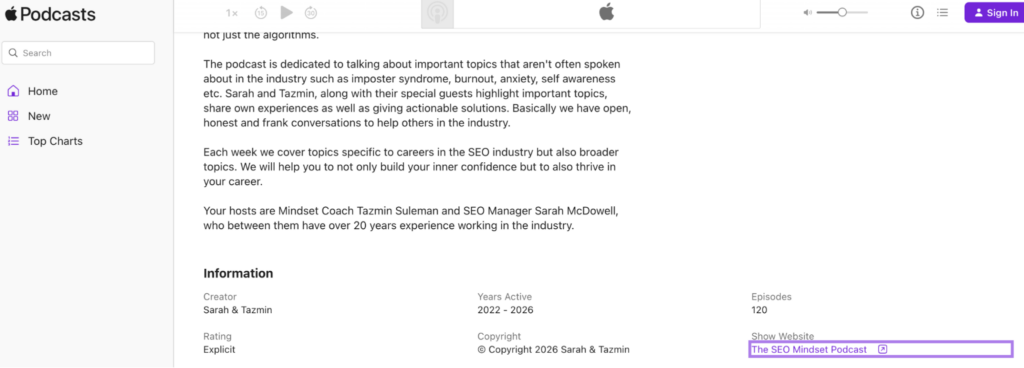
Then there are the times when you’re a guest on someone’s show, or you do a collaboration (here’s an example of when we collaborated with Search with Candour).
As you can see, the possibilities are endless, and that’s just on backlinks.
Moving on to mentions.
There will be plenty of times when someone mentions The SEO Mindset without a link, and the good news here is that this still has a positive impact. Mentions can be as simple as naming us in a social media post, in a forum like Reddit, or on any other channel, really.
Brand mentions are the digital version of ‘word-of-mouth’, and in a survey, 70% of consumers trust brand mentions more than traditional ads. It’s a signal to Google (and other search engines) that you exist, and they know this because people are actually talking about you.
Each mention helps to build a picture of your brand’s reputation, relevance and authority across the web. This all feeds into your overall brand sentiment and image.
Let’s say someone starts a Reddit thread and says, “I finally listened to The SEO Mindset Podcast, and it’s now one of my favourite go-to shows. I will make sure I never miss an episode”.
No link, but someone speaking about my podcast authentically and genuinely. Google is paying attention. They’re taking note of who is talking about you, how and where it’s happening.
The main thing to remember when you start anything new is getting the word out there, and that’s the same with podcasting. However, the beauty is that backlinks and mentions are often a by-product of creating something people find enjoyable and valuable.
Build authority on your own website and channels
Having a podcast that you showcase on your website and channels is a great way not only to demonstrate your experience and expertise, but over time, build authority on particular topics and the industry as a whole.
Let’s take my partner’s tutoring company, Limitless Learning, a tutoring company that specialises in supporting SEND children who are out of mainstream education.
She’s finally listened to my wisdom (the wise old sage I am) and has decided to start a podcast with themed seasons. The first season will explore the different types of SEND; this will be followed by the importance of play in education, and in another season, she’ll speak with industry experts.
She’ll make sure her website has a landing page for the podcast, that each season and episode has dedicated pages, and she’ll go a step further by creating resources from the episodes such as curated playlists, quizzes, worksheets and other downloadables.
I remind her that each episode needs to have useful, detailed show notes. This includes an episode overview, main takeaways, something practical to implement, transcripts, host and guest bios and links to other resources and stats discussed in episodes.
Over time, Tash will build such a library of interesting and valuable content.
This demonstrates how easy it is to use a podcast to grow a library of authoritative content that builds trust with your audience (in this example, parents, local authorities and schools). This all signals your wonderful expertise to Google and gives you something genuinely original in a world full of AI-generated noise.
And we’re just talking about the podcast episodes; there’s also repurposing it across social media, email, and outreach (more on those later).
Storytelling and showcasing real-life experience
Having a podcast allows you to create something that is (wonderfully) human and unique. You have a platform where you can tell stories and share real-life experiences.
This helps you to stand out from the swarms of generic content out there – which is important nowadays, seeing as 74% of pages created in 2025 contained AI generated content.
As a side note, it’s reassuring that of the 74%, only 2.5% is purely AI-generated, which shows people are still editing themselves before publishing.
Important caveat: I’m not coming after content that is created with the help of AI. Full transparency: I use AI to help me, it’s hard not to nowadays. I do have full respect for those who do not use it at all.
My point is more about getting the opportunity to actually connect more deeply with your audience.
You can still do your research and talk about what matters to your audience. Find trending topics (I use Google Trends and Exploding Topics), use keyword and query research tools (Also Asked is fab), and survey your audience (both online and in-person).
But rather than ‘rinse and repeat’ what is already out there, you can do better, armed with your research. You can plan an episode where you not only talk about the topic, but also give your unique perspective (based on your expertise) and give examples from real life to show your experience.
Go a step further and invite other authoritative voices to have a meaningful discussion (your unique POV may be different from the ‘norm’) and prove that you’re the trusted voice(s) on that particular subject.
Notice the words I highlighted in the two paragraphs? That’s your E-E-A-T sorted, mate.
Just make sure that you’re showcasing this on your website and individual podcast episode pages.
Jump back to the Build authority on your own website and channels, if you’re confused. If you paid attention, we have covered this*.
*Yes, that is sass.
Repurposing content to amplify authority
There is so much content that can be created from one mere podcast episode.
Use the transcript and turn it into a blog that you can post on your own website or places like Medium or LinkedIn.
Take audio or video snippets from the podcast episode and use them for YouTube Shorts, Instagram Reels and other social media videos.
Summarise the main key takeaways and create long-form posts on LinkedIn, or create images or carousels to share on your channels.
Monitor conversations on Reddit or other forums (Mumsnet for the tutoring example I used earlier), get involved and mention the podcast and episodes when relevant (making sure to stick to the Sub-Reddit rules).
Repurposing is much more than being efficient with your content. Each format that you create reaches a different audience and reinforces the same underlying authority signal across the web, which Google will take note of.
Another point to raise is that common places AI pulls information from include Reddit, YouTube and LinkedIn. Why? Because they have real, conversational human insights that AI models often use when answering trickier questions.
So it’s a win-win. E-E-A-T sorted, AND you get cited by AI.
What should I do next?
What you should do next depends on whether you have a podcast, or you are toying with the idea of starting one.
Already have a podcast?
I recommend these 3 actions:
- Get your podcast on your website (if you haven’t already), and make sure every episode has a dedicated page with detailed show notes and transcripts.
- Each time you have a guest, make it super easy for them to share your episode. Pull out interesting things that they said. Create a graphic or video/audio snippet. Share the embed code and invite them to use it on their website.
- Ask listeners to recommend your podcast and episodes. Next time they’re down a Reddit rabbit hole and someone asks for a podcast recommendation, they can mention you. Make sure they’re following you on social media, and ask them to share posts with their audience.

How to Start a Podcast: Complete Step-by-Step Guide (2026)
Read article called: How to Start a Podcast: Complete Step-by-Step Guide (2026)Thinking of starting a podcast?
I recommend these 3 actions:
- In the words of my partner’s school teacher, “proper preparation prevents poor performance”. Of course, there is a lot to explore when starting a podcast, so I’ll stick to the angle of this article, which is E-E-A-T. When planning your topic, think about what you want to be known for. What topic do you have ample amounts of expertise, experience, authority and trust in? Get ahead and plan 5 to 10 episodes, or think about the different themes you want to explore.
- During the set-up phase, having a plan to showcase your podcast and episodes on your website is just as important as the other elements. Don’t leave it to the last minute or on the day of your launch.
- During the launch phase, get out there talking about your podcast. Having a trailer will massively help, as you have something to tease listeners with – make sure to ask them to follow so they’re notified when your first episodes are live.
It just so happens that I am a freelance marketing consultant and podcast producer and offer a free 30-minute consultation, which you can book here.
Final thoughts on E-E-A-Ting
So, there you have it. Next time you hear someone mention E-E-A-T, you can now be smug, knowing that you understand this SEO jargon.
Quick summary: it’s Google’s way of figuring out who actually knows what they’re talking about, and they have the evidence to prove it.
I’ve also proved that a podcast is a serious contender when thinking about your marketing and business strategy. It ticks every E-E-A-T box.
Get backlinks and mentions organically, and watch your website become a library of wonderfully human content that is original and authoritative.
Whether you’re starting from scratch or already have a podcast, the principle remains the same: don’t be afraid to show up as you and let your experiences/expertise do the talking (excuse the pun).
Now go out there and E-E-A-T up all that podcasting goodness.
Sarah is a freelance podcast producer and digital marketing consultant. With her varied experience and expertise she helps other podcasters to succeed. She’s launched, grown and montised her own podcasts, worked in marketing and SEO since 2012, and has been the SEO manager for the renowned podcast hosting platform, Captivate. Beyond consulting, Sarah is an international speaker, awards judge, and mentor, and she’s co-authored two books. She also runs a small podcasting community and operates a podcast recording studio in the UK.